Metal Wallet vs Leather Wallet: An Honest Comparison (2026)
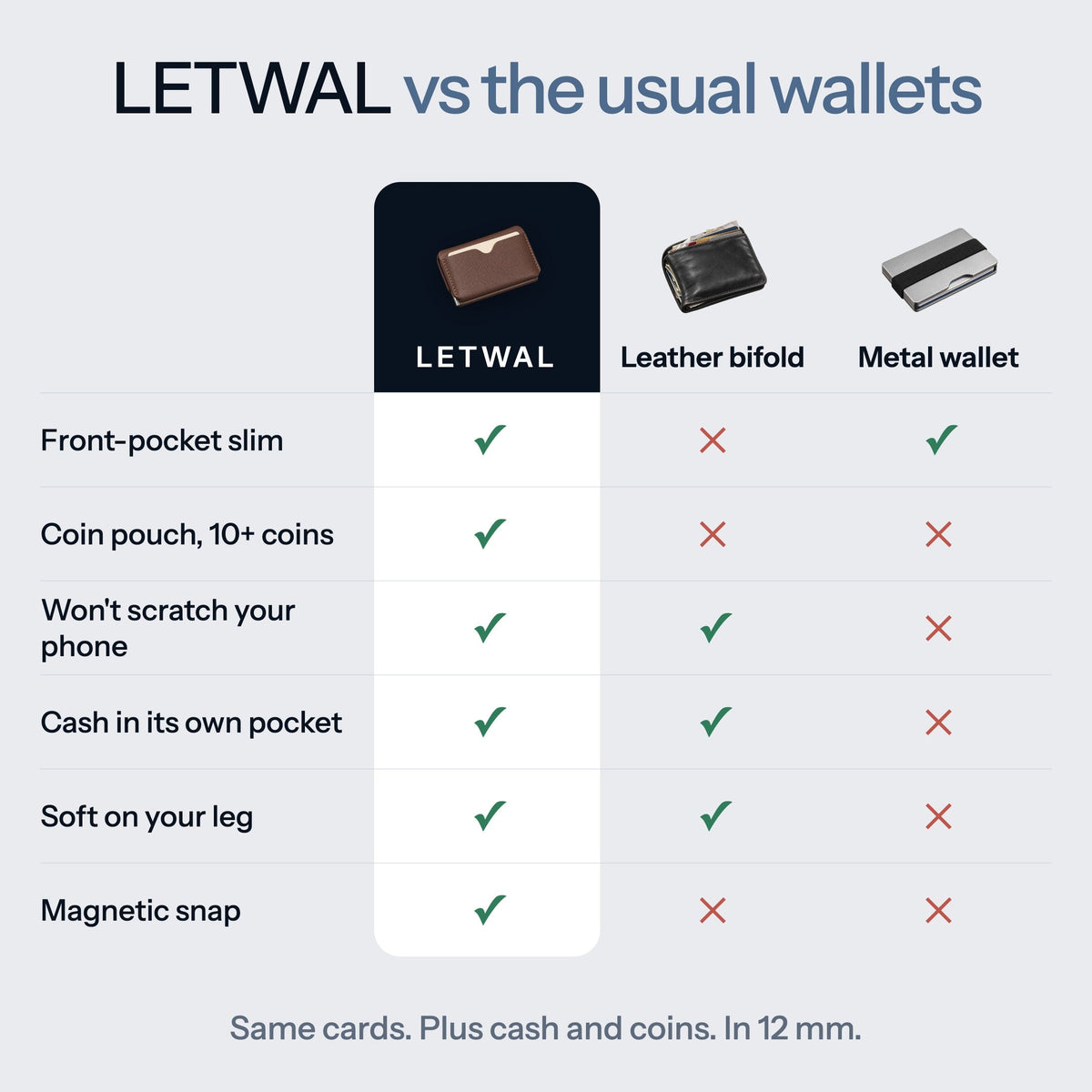
Metal card wallets had a moment. They looked like something a movie hacker would carry, they promised to block every signal known to science, and they made a satisfying clack on a café table. A few years on, plenty of people have quietly gone back to leather. Here is an honest look at why, with real numbers where we could find them.
Metal wallet vs leather wallet at a glance
| Metal card wallet | Slim leather wallet | |
|---|---|---|
| Typical weight | About 45–71 g (1.6–2.5 oz) for popular aluminum, carbon fiber and titanium models | Roughly 48–100 g for slim sleeves and card wallets |
| Shape | Rigid box, about 86 × 54 × 6 mm before cards | Soft, molds to your pocket over time |
| Cards | Up to about 12, held by an elastic band | Usually 4–8 |
| Cash | Folded under an outside clip or band | Often its own pocket |
| Coins | Usually no place for them | Some designs, like LETWAL, add a coin pouch |
| Feel in the pocket | Hard edges, can knock against your phone and keys | Soft, quiet |
| Contactless (RFID) blocking | A metal shell helps by its nature | Needs a blocking lining |
| Ages like | Scratches and anodizing wear | Patina, if the leather is good |
Where metal wallets are genuinely good
Credit where it is due. A metal wallet is tough. You can drop it, sit on it, and it will be fine. Popular models are also light: Ridge lists its aluminum wallet at about 2 oz (57 g) and its titanium version at about 2.5 oz (71 g), with a carbon fiber option around 1.6 oz. And because a closed metal case is a conductor, it naturally makes contactless cards harder to read from outside, which is why "RFID blocking" became a big part of the pitch.
If you carry 10 or more cards, do not use cash and love the industrial look, a metal wallet can be the right call.
Why metal wallets feel outdated for everyday carry
1. Your pocket is not a toolbox
A rigid metal box does not bend with you. In a front pocket it presses on your leg when you sit, and it shares that pocket with a phone that has a glass back and a screen. Metal against glass is not a friendship. Leather is soft, so it simply moves with you.
2. Getting one card out is a ritual
Most metal wallets hold cards in a tight stack. You push the whole stack out with your thumb, fan it, pick the card, then squeeze the rest back in against the elastic. Great finger workout. Less great at a busy checkout.
3. Coins have nowhere to go
Most metal card wallets have no coin compartment at all. In the US that means loose change rattling around your pocket. In Europe, where €1 and €2 coins are real money, it is a deal-breaker. A soft wallet can have a small pouch that holds coins without adding much thickness.
4. Cash is an afterthought
Cash is still very much alive: in the Federal Reserve's 2026 payments diary, 76% of US consumers had cash on them, about $69 on average. On a metal wallet that cash usually goes under a clip on the outside. On a leather wallet it gets its own pocket.
5. The RFID argument matters less than it sounds
Contactless cards only work within a couple of inches, and every tap creates a one-time code, so skimmed data is hard to reuse. Blocking is a nice bonus, not a reason to carry a brick. We wrote a whole post on it: Do RFID-blocking wallets actually work?
What to look for in a slim leather wallet instead
- Thickness under about 15 mm loaded. Thin enough for a front pocket.
- Room for the 4–6 cards you actually use. The average American has 3.7 active credit cards, according to Experian.
- A real cash pocket, not a clip.
- A place for coins or a key, if you use them.
- A closure that stays shut, like a magnetic snap, so nothing slides out.
- A contactless-blocking lining if you want the RFID benefit of metal without the metal.
- A warranty that tells you the maker expects it to last.
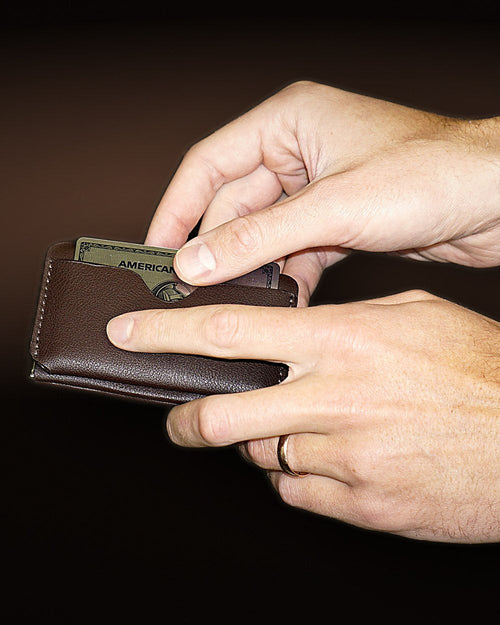
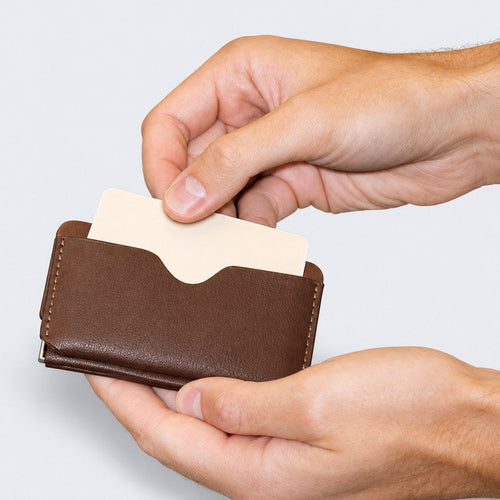
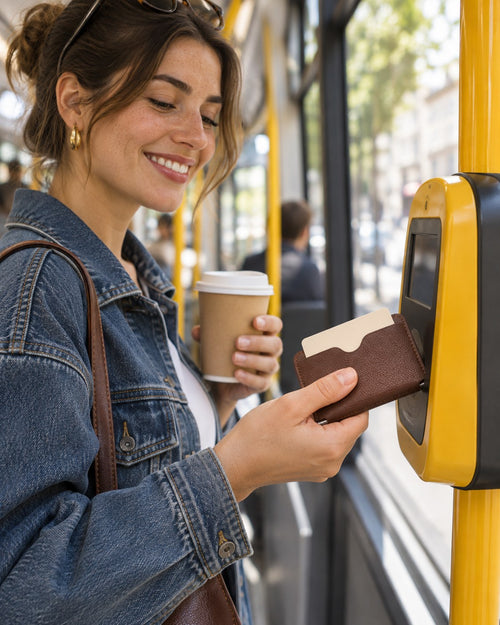
That is more or less the list we built the LETWAL Click Wallet from: 11 × 6 × 1.2 cm, pebbled leather, up to 6 cards, folded cash and 10+ coins or a key, a magnetic snap and a lifetime guarantee. Yes, we are biased. That is why we gave you the table first.
FAQ
Are metal wallets bad for your phone?
They can be. A hard metal edge rubbing against glass or a phone frame in the same pocket can scuff it. Keeping the phone in a different pocket, or using a soft wallet, avoids the problem.
Are metal wallets better than leather?
Metal wins on toughness and holds more cards. Leather wins on comfort, cash and coins, and how it looks after a few years. For most everyday carry, a slim leather wallet is the more comfortable choice.
Do metal wallets protect credit cards?
A closed metal case does make contactless cards harder to read, and so does a leather wallet with a blocking lining. Real-world contactless skimming is rare, so treat it as a bonus feature.
How much does a metal wallet weigh?
Popular models weigh about 45–71 g (1.6–2.5 oz) empty, depending on whether they are carbon fiber, aluminum or titanium.
Sources
- Ridge, product pages and FAQ for the aluminum, titanium and carbon fiber wallets (weights, dimensions, capacity), ridge.com, 2025–2026.
- Federal Reserve Financial Services, 2026 Findings from the Diary of Consumer Payment Choice, May 2026.
- Experian, Average number of credit cards a person has, August 2025.
- Secure Technology Alliance, Contactless Payment Security Q&A, 2016.

Carry less
LETWAL Click Wallet
12 mm thin pebbled leather. Up to 6 cards, folded cash and 10+ coins or a key. Magnetic snap, free shipping, 30-day money-back.
See the wallet